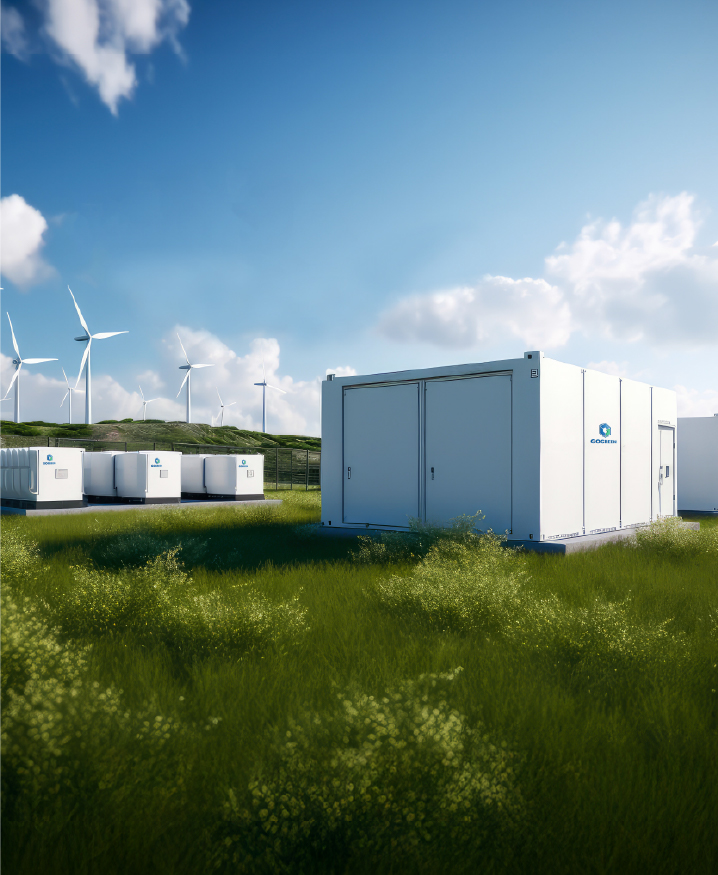
The Evolution of Containerized Energy Storage Systems: Why Modular Design Is the Future
Fun Facts of BESS
Containerized energy storage is transforming how we build and deploy power infrastructure.
From factory-built precision to plug-and-play scalability, modular ESS is rewriting the rulebook for how fast, flexible, and efficient clean energy can be.
In today's race toward a carbon-neutral world, energy storage systems (ESS) are no longer a luxury — they're the backbone of modern energy infrastructure.
And among all configurations, one design has rapidly risen to the top: Containerized, modular ESS. It's fast to deploy, easy to scale, and designed for the unpredictable energy future ahead.
So what makes modular containerized ESS the new industry standard? Let's dive in.
From On-Site Construction to Plug-and-Play Modules
Not long ago, large-scale battery projects were built like power plants —
Custom buildings, months of civil works, and endless coordination between battery, inverter, and BOS suppliers.
Today, that's changing.
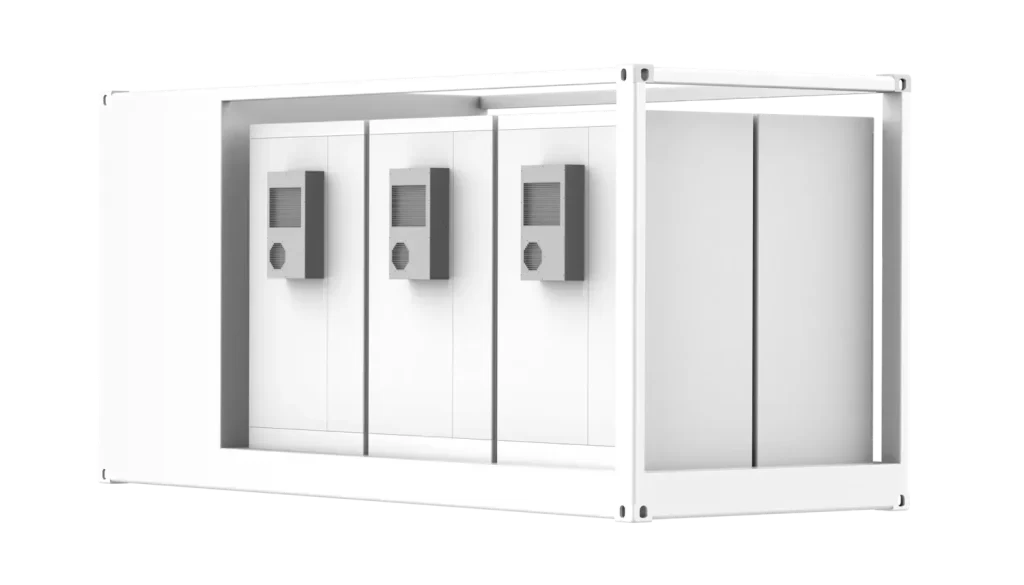
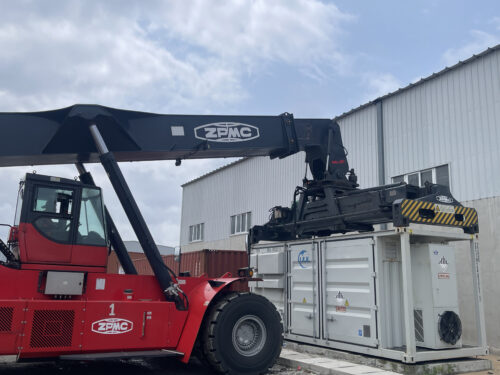
Containerized ESS shifts the paradigm from field construction to factory integration. Each 20 ft or 40 ft unit arrives pre-assembled, pre-tested, and ready to plug in.
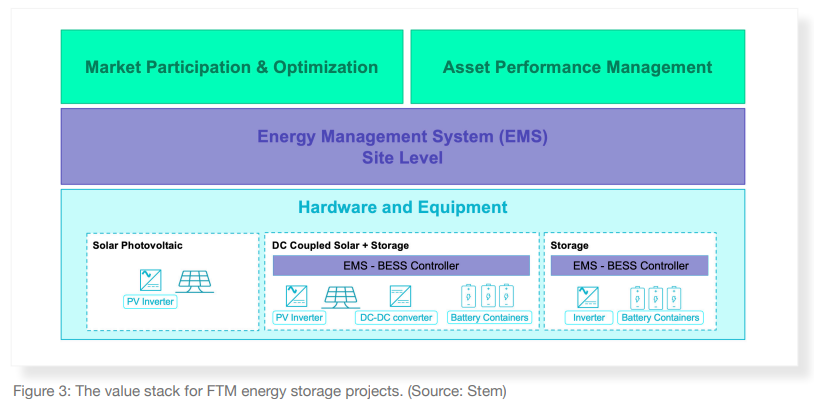
A modular approach to front-of-the-meter storage has emerged — allowing developers to mix & match hardware from different vendors and shorten time-to-market. — Stem, Inc. eBook (2024)
This model has become the go-to standard for commercial, industrial, and utility projects worldwide.
Why Modular Design Wins?
1️⃣ Scalability & Flexibility
Need 2 MWh today but 10 MWh next year? Just add more containers — no redesign required.
This “building-block” concept lets projects grow with energy demand while keeping the same footprint and interface.
2️⃣ Rapid Deployment
Containerized ESS can be installed in days, not months. Factory testing means fewer site surprises and faster commissioning — a clear advantage where grid-connection windows are tight.
3️⃣ Cost & Efficiency
Because production happens in a controlled, factory environment, every process — from battery stacking to busbar welding — is optimized for consistency and scale.
Labor costs drop thanks to automation and repeatable workflows. Material waste is minimized, with precision manufacturing and tighter QA standards. Rollout can be phased, allowing investors to align deployment with cash flow and local market incentives instead of a single massive CAPEX outlay.
Beyond initial savings, modular ESS also reduces lifetime ownership costs: standardized parts simplify maintenance, shorten downtime, and allow quicker swap-outs when technology upgrades arrive.
In short — you save twice: once at installation, and again every year in operation.
4️⃣ Standardization & Reliability
Modular containers follow standard footprints and interfaces. That means easier certification, faster logistics, and simplified maintenance — the very things EPCs and O&M teams love.
5️⃣ Resilience & Mobility
Each container is self-contained and transport-ready. Whether for remote microgrids, C&I parks, or emergency backup, they can be redeployed or repurposed in a matter of days.
Market Momentum
According to Data Intelo, the container-type ESS market is projected to grow from USD 4.5 billion in 2023 to USD 12.7 billion by 2032, fueled by demand for scalable and relocatable storage.
And with battery costs down 90 % over 15 years (IEA 2024), the economics have never been more compelling.
What This Means for the C&I Sector
For industrial and commercial users — factories, data centers, logistics parks — modular ESS offers:
Start small, expand later.
Quicker ROI through rapid deployment.
Simplified permitting and logistics.
Lower O&M risk through standardization.
Future-proof scaling for PV + EV + microgrid upgrades.
In short: deploy now, grow when ready.
Key Challenges to Watch
Even the best designs need attention to detail.
🔸 Thermal management and fire suppression must be carefully engineered inside compact enclosures.
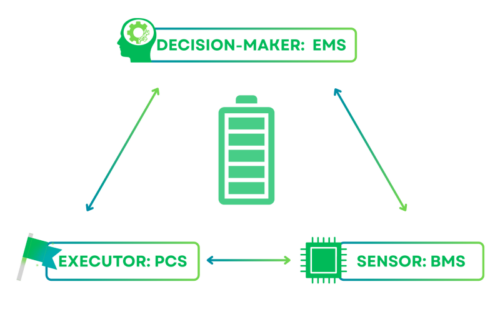
🔸 Integration across multiple containers demands a capable EMS/BMS for balancing and coordinated control.
🔸 Permitting and site logistics — cranes, road access, interconnection — still need local expertise.
“Modularity adds flexibility, but also complexity in orchestration.” — Stem eBook, 2024
The Road Ahead
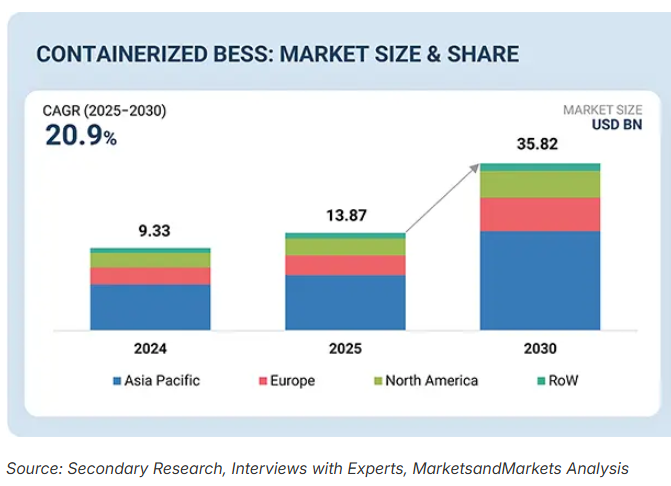
The global containerized BESS market is projected to grow from USD 13.87 billion in 2025 to USD 35.82 billion by 2030, at a CAGR of 20.9%. This robust growth is fueled by the increasing integration of renewable energy sources, the rising demand for grid flexibility, and the need for reliable backup power across residential, commercial, and utility sectors. The next generation of containerized ESS is already here: