Understanding the “3S System” in Energy Storage: BMS, EMS, and PCS
BMS, EMS,and PCS
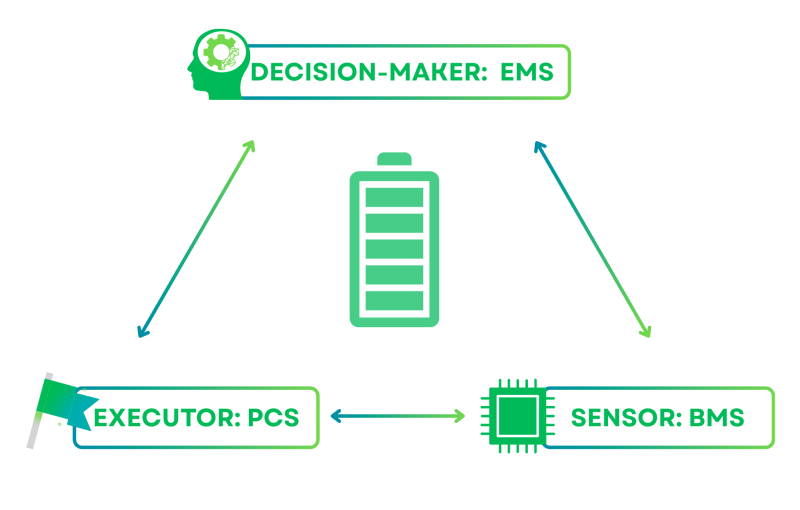
In the world of Energy Storage, the "3S System" refers to the three core components: the Battery Management System (BMS), the Energy Management System (EMS), and the Power Conversion System (PCS).
In the world of Energy Storage, the "3S System" refers to the three core components: the Battery Management System (BMS), the Energy Management System (EMS), and the Power Conversion System (PCS). These three systems work in perfect synergy to ensure the safety, stability, and efficiency of energy storage operations.
The operational logic is simple yet highly coordinated:
The battery pack relays its status to the BMS.
The BMS shares this information with the EMS and PCS.
The EMS issues optimized scheduling decisions, sending control commands to both the PCS and BMS to manage battery charging and discharging activities.
Each system plays a crucial role:
BMS serves as the sensor, focusing on monitoring, assessing, balancing, and protecting the battery.
EMS acts as the decision-maker, responsible for data acquisition, network monitoring, and energy dispatch.
PCS functions as the executor, handling the charging and discharging processes and AC/DC conversion.
Together, they form the backbone of any modern energy storage system.
II. PCS (Power Conversion System)
The PCS is the heart of two-way energy flow between the storage system and the power grid. Its primary functions include controlling the charging and discharging of the battery pack and managing AC/DC conversion.
PCS Working Principles: Using a controllable, four-quadrant operating converter, the PCS enables seamless bidirectional energy exchange. It responds to microgrid control commands, providing constant power or current control, facilitating smooth integration with renewable energy sources like solar and wind.
PCS Classifications Based on Application Scenarios:
Utility-Scale Energy Storage Stations: Power ratings over 10MW, using cascaded multi-level topologies with IGBT modules. Multiple PCS units are containerized and connected to the grid via transformers.
Centralized Commercial Applications: Power ratings above 250KW, typically using two-level topologies. Compact and modular, these PCS units can reach megawatt capacities with high reliability.
Industrial and Commercial (C&I) Systems: Power ratings below 250KW, often combined with distributed photovoltaics. They enable peak shaving and enhanced self-consumption for businesses.
Residential Systems: Power ratings below 10KW, integrated with home solar setups. They offer emergency backup power and optimize household energy costs, with higher standards for noise reduction and safety.
III. BMS (Battery Management System)
The Battery Management System (BMS) ensures the safe, efficient operation of batteries by measuring critical parameters such as voltage, current, and temperature, while managing charging cycles to extend battery life.
BMS Hierarchical Architecture:
BMU (Battery Module Unit)
BCU (Battery Control Unit)
BAU (Battery Array Unit)
Monitors individual cell parameters, calculates State of Charge (SOC) and State of Health (SOH), and handles cell balancing. It uploads abnormal information to the master controller.
Oversees entire battery packs, implementing control strategies based on BMU data. It manages charge/discharge processes and ensures consistency among cells.
Supervises entire battery arrays. It performs advanced system coordination, fault diagnostics, and external communications with EMS and PCS to maintain system-wide balance and safety.
IV. EMS (Energy Management System)
The Energy Management System (EMS) is the brain of the energy storage system. It integrates hardware and software to monitor, control, analyze, and optimize system operations.
EMS System Structure:
Device Layer: Interfaces with PCS, BMS, and other sensors.
Communication Layer: Manages data protocols, links, and transmissions.
Information Layer: Utilizes middleware, databases, and servers to store and process data.
Application Layer: Provides user-friendly platforms like mobile apps and web portals for visualization, monitoring, and operational control.
Through real-time data collection and intelligent energy dispatching, the EMS ensures orderly, efficient system performance.
V. Gogreen Conclusion
In modern energy storage systems, BMS, EMS, and PCS form an inseparable trinity.
The BMS safeguards the health and safety of batteries.
The EMS optimizes energy usage through smart scheduling and system control.
The PCS executes the physical charging and discharging operations.
Their close collaboration underpins the reliability, safety, and efficiency essential to commercial and industrial energy storage solutions.
//blog
Related Posts
Explore the latest news and technology trends in the energy storage industry.