Grid outages are becoming more frequent across the world. From Africa's load-shedding to Europe's winter grid stress and Asia's extreme-weather events, resilience is no longer optional—it is the core reason many factories, logistics parks, and commercial buildings invest in energy storage systems (ESS).
But what actually happens inside a modern ESS the moment the grid goes down? What does the PCS “see”? How fast does the STS respond? How do PV, diesel generators, and battery modules work together during those critical seconds?
Let's walk through the behind-the-scenes process—step by step—based on modern microgrid architecture in 2025.
1. Millisecond-Level Detection: PCS Watches the Grid 24/7
Every ESS constantly monitors grid voltage, frequency, phase angle, and waveform distortion. A typical threshold for “grid abnormality” is:
Voltage deviation > ±10%
Frequency deviation > ±0.5 Hz
THD outside 5% (IEEE 519 standard【1】)
The moment any of these exceed limits, the PCS flags a disturbance.
Detection time: ⏱ < 2 ms (typical for modern DSP-based control boards)
This early warning is crucial—milliseconds matter.
2. Seamless Switching: STS Transfers to Off-Grid Mode Within 10 ms
A modern microgrid uses an STS (Static Transfer Switch) to disconnect the load from the failing grid.
Why STS? Because mechanical switches are too slow.
Mechanical ATS: 0.3–0.6 s
STS: <10 ms
In practice, high-performance STS in C&I microgrids can achieve:
➡️ 4–8 ms real switching time
For the factory, the lights don't flicker. For servers, PLCs, EV chargers, and industrial equipment, it feels like nothing happened.
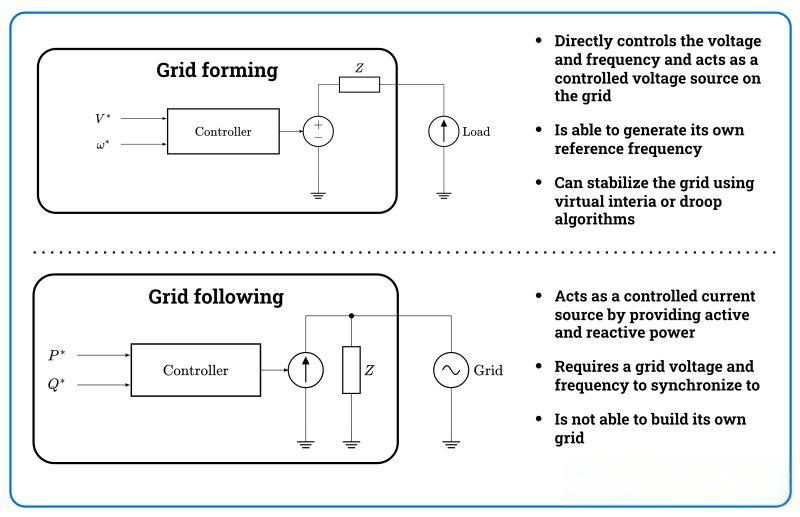
3. Inverter Reconfiguration: PCS Becomes the “New Grid”
Once isolated, the ESS must form a new microgrid instantly.
The PCS switches from:
⚡ Grid-following mode → Grid-forming mode
In grid-forming mode, it must provide:
Voltage reference
Frequency reference
Reactive power support
Short-circuit response
Harmonic suppression
Essentially, the PCS becomes a virtual power plant inside the building.
This transition typically completes within 10–20 ms, thanks to modern fast-response vector-control algorithms.
Grid forming VS Grid following
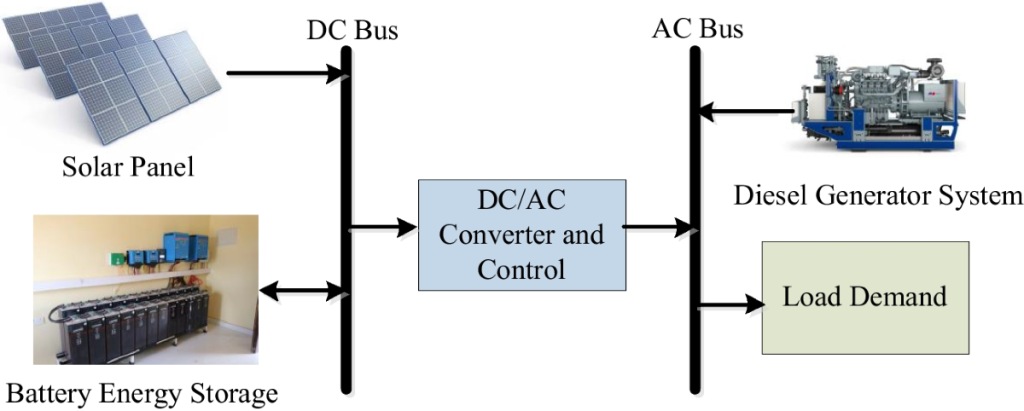
4. PV + Battery Priority Logic Takes Over
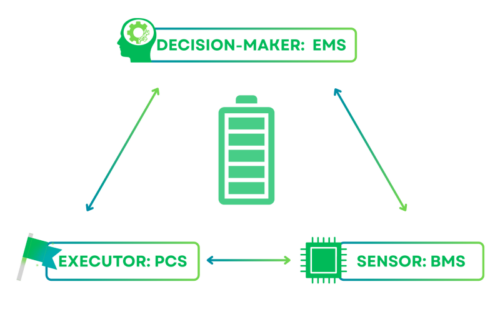
Once the microgrid stabilizes, the EMS activates its off-grid optimization logic:
A. PV takes priority
The EMS maximizes solar output to support loads:
Reduce battery discharge
Stabilize inverter utilization
Lower diesel generator runtime (if present)
MPPT modules continue working normally in the microgrid.
B. Battery provides the backbone
Battery output is adjusted every 100–200 ms via droop curves.
High-C-rate LFP cells (like today's 280–314 Ah ESS cells) provide very stable off-grid performance and low-voltage sag.
C. Diesel (if included in the microgrid) stays on standby
EMS starts the genset only if:
PV is insufficient
Battery SOC < alarm threshold
Peak load exceeds inverter capability
This hybrid logic ensures both cost efficiency and longevity.
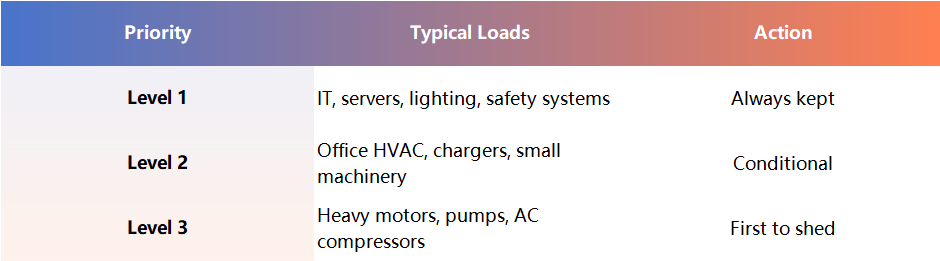
5. Load Management: Some Loads Stay, Some Shed
During outages, the EMS may automatically cut noncritical loads based on preset priority levels.
This prevents system overload and keeps the microgrid stable.
6. Reconnection to the Grid: Only When It's Truly Stable
Once the grid recovers, reconnection is not immediate.
IEEE 1547 and many national grid codes require:
Grid stable for ≥5 minutes
Frequency within ±0.2–0.5 Hz
Voltage within nominal limits
The PCS then synchronizes:
Phase angle
Voltage
Frequency
After synchronization, the STS closes the loop and loads transfer back to the grid.
Total reconnection time is typically 5–10 minutes.
Why This Matters in 2025
The entire process—from outage detection to forming a stable microgrid—happens in under 20 milliseconds. This level of resilience used to require diesel microgrids or UPS systems. Now, ESS replaces both.
For countries with unstable grids—South Africa, Kenya, Pakistan, Iraq, the Philippines—this capability is not a luxury. It is the core value of C&I energy storage deployment.
And as more factories combine:
PV
ESS
Diesel
Smart EMS
Modular PCS architecture
…the future of energy resilience lies in next-generation hybrid microgrids, not just batteries.